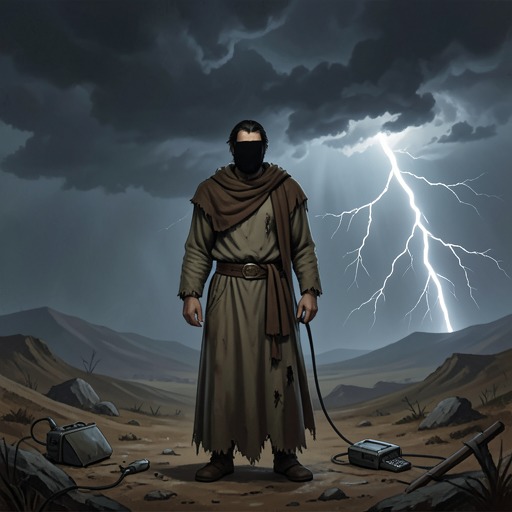
Gibreel punishes pimps with the horn of Azraeel
The Satanic VersesIn the Goodsway, Gibreel Farishta turns from a group of exploited children’s silent appeal to their pimps, then kills the approaching men with the horn Azraeel. The episode is a decisive turn in his understanding of himself: after the attack, he identifies as the Archangel Gibreel, an agent able to make people’s inward desires real. Yet the scene places that claimed power beside the vulnerable people it appears to serve, and foreshadows his movement toward a much larger vision of punishment by fire.
Setting and the children’s circumstances
The encounter takes place on the Goodsway, among railway termini and industrial structures in north London. The setting is described as a place of commerce, but here the goods on offer are children. They are between thirteen and fifteen, have been expelled from their homes, and are exploited by pimps who take ninety per cent of their earnings. The description makes their apparent presence in the street inseparable from poverty, abandonment, and coercion; the children are treated as commodities by the people profiting from them.
Gibreel initially passes through the area wanting no involvement. He hears the children calling from doorways and lamps, but at first tries to dismiss their plight as unrelated to him. His pace changes as he becomes aware of a plea beneath the voices. The shift is significant: the encounter begins not with a plan to intervene but with his inability to continue past them. Their appeal holds him in place, and, as they draw near, their appearance no longer conceals their youth. They kneel before him, making their need legible without speaking.
The intervention
The children’s silent appeal leads Gibreel to wait among them for the pimps. He does not leave when they approach. Instead, he takes out Azraeel, the golden trumpet he carries, and presses it to his lips. A stream of fire emerges from the horn and consumes the men; the account describes their destruction as complete, leaving not even their shoes behind.
The sequence gives the children’s appeal an immediate consequence: the men exploiting them are killed, and Gibreel leaves with the children’s gratitude. But the episode does not present the intervention as an ordinary rescue. The instrument’s supernatural power makes Gibreel’s response absolute, converting an encounter with specific abusers into an act of extermination. The contrast between the children, whose need draws him to stop, and the men, whom he destroys, establishes the stark moral division through which he understands the scene.
Azraeel and Gibreel’s self-understanding
After the attack, Gibreel understands himself as the Archangel Gibreel, the angel of the Recitation. He interprets the power in his hands as the ability to reach into people and bring their deepest desires into reality: he is, in his own emerging conception, both the fulfiller of dreams and the quencher of desires. The horn is therefore more than a weapon in the scene. Its use confirms for Gibreel a supernatural identity and a capacity to act on the hidden wishes of others.
That certainty does not settle the question of where the power originates or how it should be judged. The episode presents Gibreel’s recognition as an experience within the unfolding narrative, not as an independent explanation of the horn’s nature. What is clear is the effect on his sense of purpose: he walks away believing that the children’s unspoken need has summoned his intervention. The rescue and the revelation become inseparable, so that violence appears to him as proof of the identity he has assumed.
From the Goodsway toward Brickhall
Gibreel leaves the Goodsway carrying Azraeel again and heads toward Brickhall. The children’s gratitude remains behind him, while his attention turns to the desires and imperatives he senses in the night. He imagines the city as a place that should be cleansed by fire, extending the logic of the attack beyond the pimps who have just arrived. The movement from a specific plea to a general vision of purgation marks the episode’s ominous consequence: a power first used against those exploiting children becomes part of Gibreel’s wider, increasingly destructive mission.
The scene thus changes both the immediate balance of power and Gibreel’s understanding of himself. The pimps are dead; the children have received a reprieve from their control; and Gibreel departs convinced that he can make hidden desires real. But the fire that answers one group’s need also points toward indiscriminate destruction. The episode makes that tension central to his angelic self-image: he sees himself as an instrument of deliverance, even as his chosen means and his widening sense of mandate carry the threat of further violence.